Bohdan Luts

Katarzyna Jackowska
Szczecin Philharmonic
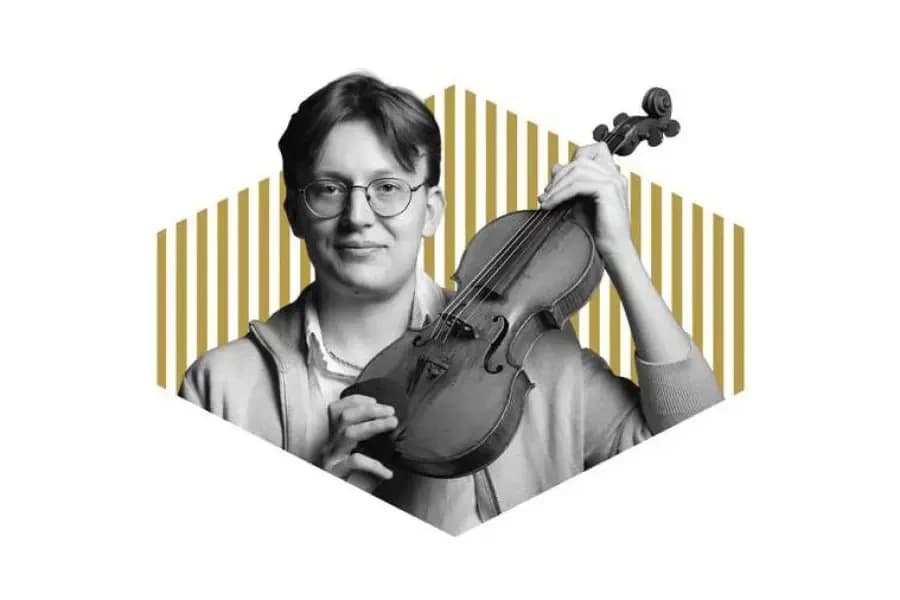
On 22 October 2026, the jury of the 17th Henryk Wieniawski International Violin Competition announced the results of this year’s edition. The winner was the Ukrainian violinist Bohdan Luts.
His previous achievements include first prizes at the Long-Thibaud International Competition in Paris and the Carl Nielsen International Competition in Denmark. He studied at the International Menuhin Music Academy in Switzerland and is currently studying in Vienna under Boris Kuschnir. In his interpretations, he particularly values freedom of expression and the richness of tone that he discovers in recordings of the great violinists of the past. As he explained in an interview with Monika Kopcik for Polish Radio’s Channel Two, his aim is not merely to impress listeners with technical brilliance, but above all to move them through music.
At the concert on 22 November, Bohdan Luts will perform Henryk Wieniawski’s Violin Concerto No. 2 in D minor, Op. 22 with the Szczecin Philharmonic Symphony Orchestra.
In inviting you to a concert featuring the winner of the First Prize of the Wieniawski Competition, we realise that there is hardly anything more to say in recommendation of this evening. Nevertheless, we shall take this opportunity to introduce the figure of the competition’s patron, for it is worth knowing the artist against whom its laureates measure themselves.
Henryk Wieniawski was born in 1835 in Lublin and was recognised as an exceptional talent from childhood. At the age of just eight, despite regulations to the contrary, he was admitted by special decree to the Paris Conservatoire, where he studied in the class of Joseph Lambert Massart. He completed his studies at the age of eleven, becoming the youngest graduate in the institution’s history. He also began a major concert career remarkably early: while still a teenager, he undertook extensive tours throughout Russia and Central Europe, and later performed in Paris, London, St Petersburg, Vienna, Berlin, and Brussels, among many other cities. He was not only a virtuoso but also a teacher at two of Europe’s leading musical institutions: the St Petersburg Conservatory and the Brussels Conservatory. Accounts of Wieniawski consistently portray an artist of extraordinary charisma, brilliant intelligence, and great personal charm.
Wieniawski travelled, performed, and composed almost without interruption, leading a life of astonishing intensity, especially considering that he suffered from serious illness during his final years. In his youth, he was compared to Paganini, while Hector Berlioz described him as one of the most outstanding violinists ever to emerge from the Paris Conservatoire. Józef Sikorski attempted to capture the remarkable energy of his playing with the words: “The force with which Mr Wieniawski captivates his listeners has something diabolical about it, something fiery and storm-laden.” He was also known for his sociability and was admired by audiences, artistic circles, and royal courts across Europe. At the same time, references survive to what might politely be described as financial recklessness and a fondness for gambling, which occasionally left him in difficult financial circumstances despite his tremendous success.
A special place in his output is occupied by his two violin concertos. The First Violin Concerto in F-sharp minor, Op. 14, was completed in 1853 and premiered at the Gewandhaus in Leipzig. One reviewer wrote after the performance that the audience had been electrified. The Second Violin Concerto in D minor, Op. 22, on which he worked for a longer period and which was eventually published in 1870, is among the finest achievements of his St Petersburg years. Toward the end of his life, he also composed a Violin Concerto in A minor, now lost and known today only through references in concert programmes and reviews. Wieniawski remained in the memory of his contemporaries as an artist whose playing was noble, poetic, and full of fire. It was precisely this combination of dazzling technique and intense expression that made him an unsurpassed model for the violinists who continue to compete in the competition that bears his name.
